
Cognitive activities for preschoolers are playful and engaging experiences that help children learn, think, and solve problems. These activities stimulate brain development and support early learning in areas like memory, attention, language, and reasoning.
Simple, everyday interactions like solving puzzles, singing songs, and playing memory games can have a powerful and positive impact on your child’s development. Below, we highlight a few fun and effective cognitive development activities for preschoolers that you can do at home or in the classroom.
Why is Cognitive Development Important?
During preschool, a child’s brain is rapidly developing, and the more opportunities children have to think and explore, the better! Simple, everyday activities and interactions that focus on “brain work” are vital to a child’s cognitive development. Cognitive development refers specifically to the ability to learn, thin
k, and problem solve. For a little activity inspiration, we’ve outlined simple suggestions that will have an enormous and positive impact on your preschooler’s developing mind.
Cognitive Development Activities for Preschoolers
There is no shortage of options for cognitive activities for preschoolers. Play based activities, exploration, reading, singing, and asking open-ended questions all strengthen a child’s math and science skills, grows their curiosity and recognition, strengthens executive functions like attention and reason, and helps them understand how they fit into the world. Not to mention, when you work on skills together in meaningful ways, you also deepen the connections between you and your child or students.
Memory Matching Game Activities
Memory games are a great way to build recall, concentration, and attention in preschoolers. The play-based nature of such games would never give away the fact that kids are learning so much while having fun! You can create simple memory games with a few classroom or household items:
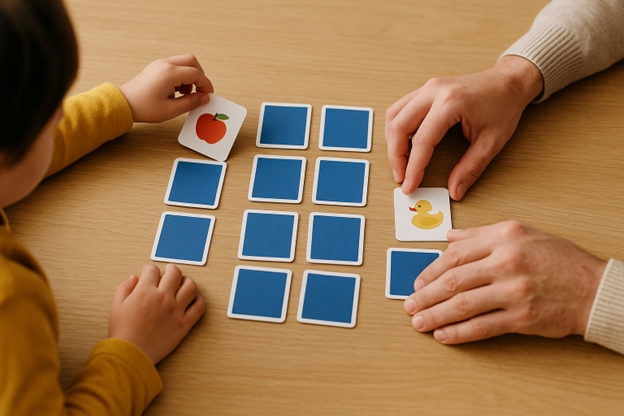
Matching card games:
- Grab a deck of cards and spread them on a flat surface, face down.
- Create the rules of the game together, are you going to find matching colors, numbers, or pictures?
- Let children take turns choosing any two cards to look for a match, like two queens.
- Take turns going back and forth.
- The act of creating a rule and searching for the match relies on children remembering where they have seen each picture in previous turns.
Magic cup game:
- Get three cups or bowls and one small rubber ball or any other small item that you’d like.
- Place the ball or item under one cup, allowing the child to see which cup the ball is under.
- Scramble the cups around.
- Ask the child to point to the cup with the item. Did they find it? Great! If not, that’s great too!
- Start from the beginning and keep going. Offer lots of positive encouragement.
- You can also choose three different color cups, or bowls or other variable to help simplify the game.
Puzzles
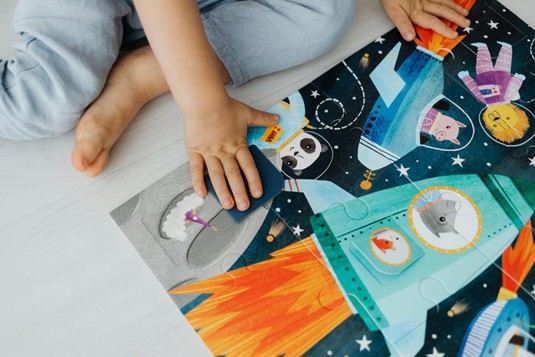
Puzzles, in all their variety, are an excellent activity to help promote essential skills and capabilities such as:
- Memory
- Fine motor skills
- Spatial awareness
- Problem solving
- Differentiation between patterns, shapes, pictures
- Logical reasoning
Whether you are in the classroom or at home, make puzzles freely available for open play or structured time throughout the day. You can sit down with children and strengthen their vocabulary and ability to solve problems logically by working on a puzzle together. Another option, perhaps when you’re on the go, is to dive into visual puzzles with online puzzles for preschoolers.
Singing, Rhyming, And Finger Play

Everyone knows a song with a rhyme makes for a very good time! Rhyming stories and songs build cognitive skills in children by introducing and expanding the rules of language, strengthening concentration, growing vocabulary, and even self-confidence. Adding finger play actions also helps to boost memory and motor skills. Gather round and a choose a song for a skills-building sing-along:
- “ABC’s Song”: Allows children to remember the alphabet
- “Head and Shoulders”: Helps children follow directions
- The Itsy Bitsy Spider: Builds memory
If you have extra time, you can even try a Create Your Very Own Guitar Craft to accompany your sing-alongs and help benefit your child’s development.
Sorting and Matching Activities
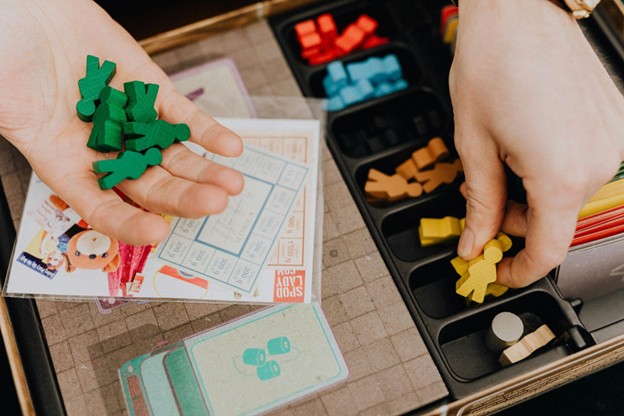
Simple sorting games are a fun way to help preschoolers practice observation and comparison skills. Whether at home or in the classroom, try offering a mix of small toys, buttons, or blocks, and encourage your child to group them by color, shape, or size.
You might ask:
- “Can you find all the red ones?”
- “Which ones are circles?”
- “Can you sort these from smallest to biggest?”
Asking questions while your child sorts helps strengthen vocabulary, critical thinking, and reasoning.
Pretend and Play Make-Believe
Imaginative play is one of the most natural (and enjoyable!) ways for young children to build cognitive skills. Whether they’re pretending to cook dinner, take care of a stuffed animal, or play school, they’re learning how to plan, organize ideas, and explore cause and effect.
Let your child take the lead. You can join in by asking, “What happens next?” or “Who are we today?” These little prompts support storytelling and problem-solving while encouraging creativity and confidence.
Everyday Counting Games
Counting can happen anytime, not just during math time. Invite your preschooler to count how many grapes are on their plate, how many blocks are stacked, or how many steps it takes to get to the door.
This kind of everyday math builds number recognition and one-to-one correspondence (one number per item counted). To stretch their thinking, you can add in simple questions like:
- “What if we eat one? How many are left?”
- “Can you give me two more?”
These activities turn daily routines into learning moments while building strong early math foundations.
Additional Resources
QSSB is a resource for parents and providers alike, with activities, information, a community supports to help children grow and develop in the first 5 years. Search parent/caretaker and early childhood provider resources here for more on development and skill building.